

Smart Home Robotics Evolution: From Vacuums to Climbing Rovers
By on February 16, 2026
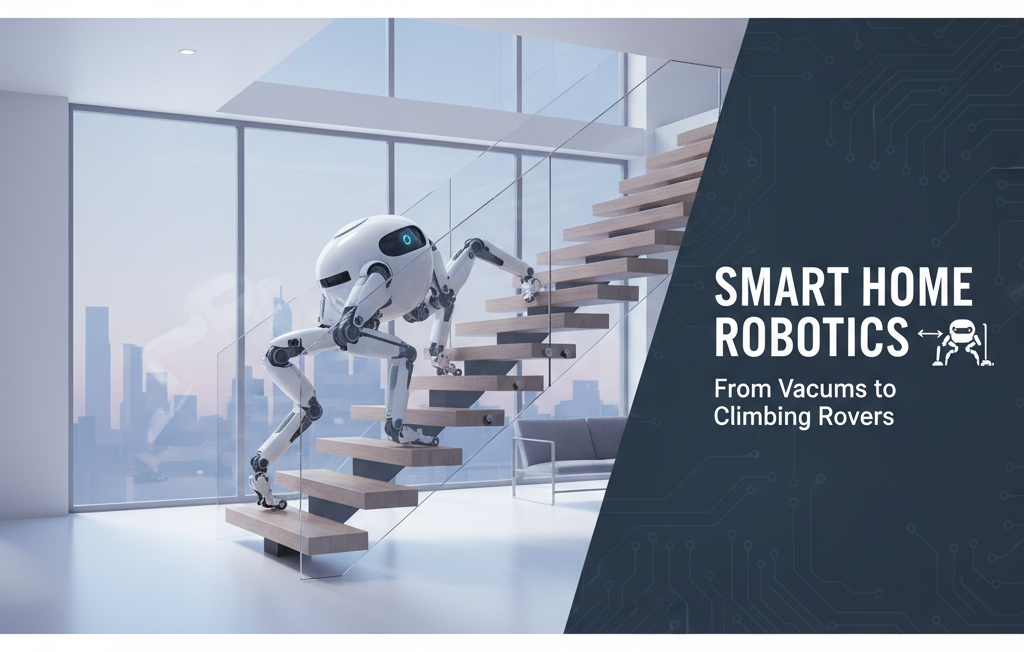
Smart Home Robotics Evolution: From Vacuums to Climbing Rovers
Imagine a home where robots do the heavy lifting—literally. The evolution of smart home robotics has transformed from simple vacuum cleaners to advanced climbing rovers that navigate stairs, redefining convenience and efficiency in our daily lives.
Key Takeaways
- Smart home robotics has progressed from basic vacuum cleaners to multifunctional robots like the Saros Rover.
- The Saros Rover features leg-like wheel-arms that mimic human biomechanics, allowing it to climb stairs.
- Autonomous learning and smarter path planning enhance the functionality of modern robots.
- Obstacle avoidance technology enables robots to navigate complex home environments effectively.
- Natural voice interaction is becoming a standard feature in smart home robotics.
- The integration of AI is pivotal in creating intuitive and responsive home robots.
- The future of home robotics looks promising with advancements in mobility and task versatility.
The Rise of Smart Vacuums
In the early 2000s, robotic vacuums like the Roomba entered the market, captivating homeowners with their ability to autonomously clean floors. These devices utilized basic sensors and pre-programmed paths to navigate rooms, marking the dawn of smart home robotics. As technology improved, these vacuums became smarter, integrating features such as Wi-Fi connectivity and mobile app controls.
The introduction of advanced models allowed for custom cleaning schedules and real-time monitoring, making them a household staple. Yet, even as they evolved, these devices remained limited to flat surfaces. The challenge of navigating stairs and uneven terrain persisted, leaving consumers yearning for more.
The Breakthrough: Climbing Rovers
Enter the Saros Rover. This innovative robot redefines what’s possible in home robotics. Equipped with independently articulating leg-like wheel-arms inspired by human biomechanics, the Saros Rover can ascend and descend staircases effortlessly. This breakthrough opens up new possibilities for cleaning, maintenance, and even companionship within multi-level homes.
The design of the Saros Rover emphasizes mobility and versatility. It’s not just a vacuum; it can transition from carpeted areas to tile, all while tackling stairs with grace. This capability fills a significant gap in the smart home ecosystem, allowing for a more comprehensive cleaning solution.
Smart Technology: The Brain Behind the Bots
The intelligence that powers today's smart home robots is rooted in cutting-edge technology. Autonomous learning algorithms enable these devices to adapt to their environments. They analyze layouts, learn optimal cleaning paths, and remember where obstacles are located. This level of sophistication was unthinkable a decade ago.
Obstacle avoidance technology plays a crucial role in ensuring that robots navigate safely. Using a combination of sensors and cameras, these robots can detect and maneuver around furniture, pets, and even unexpected messes. This feature significantly reduces the risk of damage, not just to the robot but also to the home itself.
Moreover, natural voice interaction is becoming a staple in the design of smart home robotics. Users can now instruct their devices verbally, making the experience more intuitive. Imagine telling a robot to clean the upstairs while you focus on other tasks. This integration of voice commands simplifies user interaction, catering to a more diverse audience.
The Future: Beyond Cleaning
As we look ahead, the future of smart home robotics seems limitless. The advancements in mobility and task versatility hint at a world where robots could take on various roles within the home. Beyond cleaning, potential applications include home security monitoring, elderly assistance, and even companionship for those who may feel isolated.
Integrating artificial intelligence will only enhance these capabilities. The push for smarter, more responsive robots will drive innovation, leading to devices that better understand human needs and preferences. Imagine a robot that learns your daily routine and anticipates your needs, perhaps even suggesting when to take a break or when to tidy up.
Conclusion
The journey of smart home robotics, from basic vacuums to sophisticated climbing rovers, reflects a broader trend towards automation in our daily lives. The Saros Rover and similar innovations are not just about cleaning; they symbolize a shift in how we interact with technology at home. As these robots become more integrated into our lives, they will redefine convenience, efficiency, and even companionship. The challenge now lies in embracing this evolution and exploring how it can enhance our everyday experiences. Welcome to the future—it's climbing stairs.
Entertainment

Samsung Unveils World's First 130-Inch Micro RGB TV with Next-Generation Color Technology

Hyperloop Technology 2026: Testing High-Speed Transportation at 600+ MPH

Aerospace Breakthroughs: Pantuo Pantala eVTOL and the Future of Urban Flight

How Vincent Van Gogh really lost his ear
Gaming

The LHC's Two Decades of Discovery: From Higgs Boson to Exotic Hadrons

Everything you wanted to know about The OC
History

The Evolution of Particle Accelerators: From 1980s Theory to LHC Reality

TIME's Best Inventions Hall of Fame: 25 Iconic Innovations Transforming Modern Life

JSON Schemas for Solar Panels in Energy3D, EnergyPlus, and Detection Datasets

Smart Home Robotics Evolution: From Vacuums to Climbing Rovers
Read More
Everything you wanted to know about The OC
Jane Jeffries|

Atlantis: truth or myth?
Laurie Lucas|

Some of the most wildly inaccurate historical dramas on TV and the misconceptions they bring.
Laurie Lucas|

How Vincent Van Gogh really lost his ear
Jane Jeffries|

Why do coincidences always seem to happen all the time?
Jane Jeffries|