

Hyperloop Technology 2026: Testing High-Speed Transportation at 600+ MPH
J
By Jane Jeffries on February 16, 2026
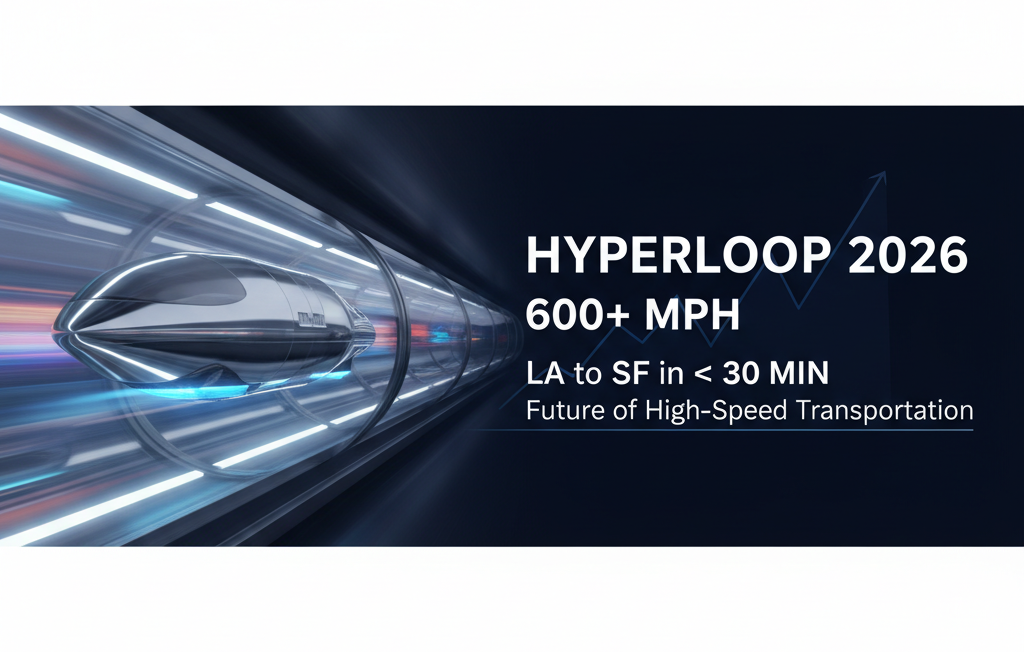
Hyperloop Technology 2026: Testing High-Speed Transportation at 600+ MPH
Imagine zipping from Los Angeles to San Francisco in under 30 minutes. Hyperloop technology, once a futuristic dream, is rapidly moving towards reality, with testing slated for 2026. As the race for high-speed transportation heats up, the Hyperloop promises a radical departure from traditional rail and air travel, offering speeds exceeding 600 miles per hour in a near-vacuum environment.
Key Takeaways
- Hyperloop technology utilizes a near-vacuum tube system to significantly reduce aerodynamic drag.
- Speeds can reach over 600 miles per hour, cutting travel time drastically.
- The Boring Company is pioneering Hyperloop development alongside other innovators in the field.
- Testing for the Hyperloop is expected to begin in 2026, with several prototypes in the pipeline.
- The technology emphasizes sustainability, aiming for a minimal environmental impact.
- Interest from governments and private investors is growing, signaling a potential shift in transportation infrastructure.
- Successful implementation could reshape urban mobility and economic landscapes.
The Mechanics of Hyperloop
At the core of Hyperloop technology is a simple yet powerful principle: minimizing air resistance. Traditional modes of transportation like cars and planes face significant aerodynamic drag, which slows them down. Hyperloop’s design, featuring pods traveling through a near-vacuum tube, nearly eliminates this drag. This allows for unprecedented speeds. Imagine a train that can travel faster than a commercial jetliner without the need for complex aerodynamics.
The technology relies on magnetic levitation, which allows pods to hover above the track, further reducing friction. This combination of vacuum tubes and magnetic levitation creates a smooth ride that promises to revolutionize how we think about intercity travel.
The Journey to 2026
As we approach 2026, several companies, including The Boring Company, are leading the charge in developing Hyperloop technology. Their focus is not just on speed but also on safety and sustainability. The Boring Company has already made headlines by proposing tunnel systems that could serve as Hyperloop routes, potentially easing congestion in major cities.
Various prototype tests are underway, with some facilities already showcasing the technology's capabilities. These tests are crucial for validating the engineering principles behind Hyperloop, addressing safety concerns, and understanding the economic implications of such a massive infrastructure project.
Sustainability and Economic Impact
One of the most compelling aspects of Hyperloop technology is its potential for sustainable transportation. The system is designed to run on renewable energy sources, minimizing its carbon footprint. As cities around the world grapple with pollution and traffic congestion, Hyperloop could offer a cleaner alternative to existing transportation methods.
Moreover, the economic implications are vast. Hyperloop could facilitate faster commuting, potentially reshaping job markets and urban planning. Imagine workers commuting from suburban areas to urban centers in a fraction of the time it currently takes. This could lead to increased productivity and a reimagining of where people choose to live and work.
Challenges Ahead
While the promise of Hyperloop is enticing, challenges abound. Regulatory hurdles, land acquisition issues, and public acceptance pose significant obstacles. Additionally, the technology must demonstrate reliability and safety through rigorous testing.
Critics often question whether the investment required for Hyperloop can be justified when existing transportation networks already exist. However, proponents argue that the long-term benefits, including reduced travel times and environmental impacts, far outweigh these concerns.
Conclusion
Hyperloop technology represents a bold step into the future of transportation. As testing approaches in 2026, the implications for travel, urban development, and sustainability are profound. Will this high-speed marvel become a staple of our transportation infrastructure, or will it remain a tantalizing vision? As we watch the developments unfold, the excitement around Hyperloop is palpable. It challenges us to rethink mobility in a rapidly changing world and consider how we can integrate such revolutionary technology into our daily lives. The future is rushing toward us at over 600 miles per hour—will we be ready to hop on board?
Entertainment

Samsung Unveils World's First 130-Inch Micro RGB TV with Next-Generation Color Technology

Hyperloop Technology 2026: Testing High-Speed Transportation at 600+ MPH

Aerospace Breakthroughs: Pantuo Pantala eVTOL and the Future of Urban Flight

How Vincent Van Gogh really lost his ear
Gaming

The LHC's Two Decades of Discovery: From Higgs Boson to Exotic Hadrons

Everything you wanted to know about The OC
History

The Evolution of Particle Accelerators: From 1980s Theory to LHC Reality

TIME's Best Inventions Hall of Fame: 25 Iconic Innovations Transforming Modern Life

JSON Schemas for Solar Panels in Energy3D, EnergyPlus, and Detection Datasets

Smart Home Robotics Evolution: From Vacuums to Climbing Rovers
Read More
Everything you wanted to know about The OC
Jane Jeffries|

Atlantis: truth or myth?
Laurie Lucas|

Some of the most wildly inaccurate historical dramas on TV and the misconceptions they bring.
Laurie Lucas|

How Vincent Van Gogh really lost his ear
Jane Jeffries|

Why do coincidences always seem to happen all the time?
Jane Jeffries|