

Max Space's Thunderbird Station: Revolutionizing Orbital Habitats with Expandable Private Space Stations
By on February 16, 2026
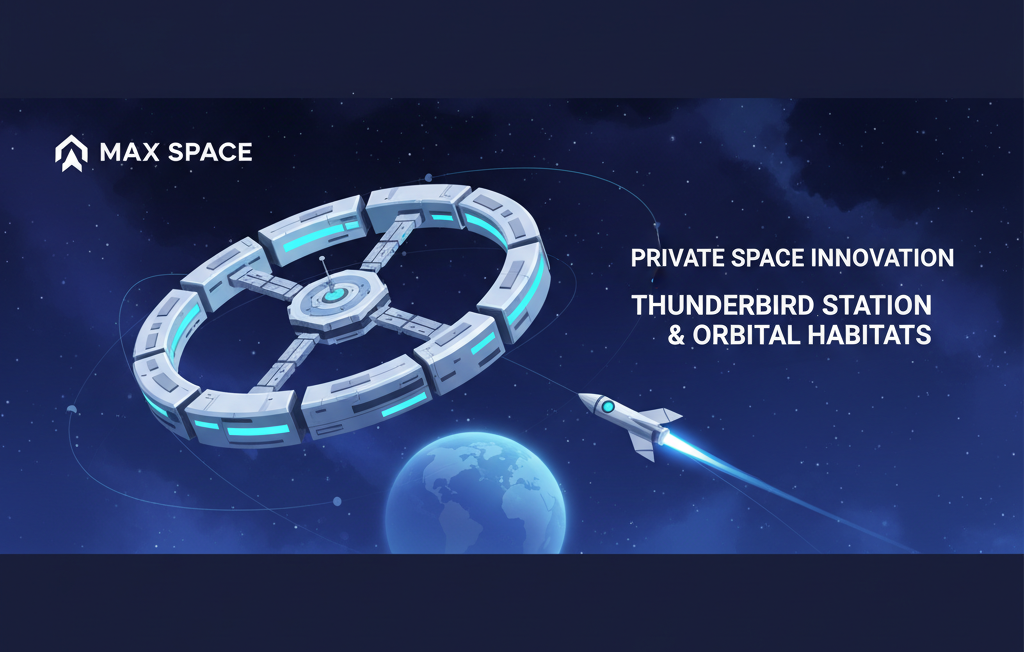
Private Space Innovation: Max Space's Thunderbird Station and Orbital Habitats
The era of private space ventures is upon us, and no player is making more waves than Max Space. Based in Florida, the company is redefining how we think about orbital habitats and the future of human presence beyond our planet. Their flagship project, Thunderbird Station, is a bold vision that promises to shift the paradigm of space utilization.
Key Takeaways
- Max Space is developing Thunderbird Station, an orbital habitat aimed at enhancing human presence in low Earth orbit.
- The company focuses on advanced space real estate, offering innovative solutions for scientific research and commercial ventures.
- Thunderbird Station is designed to support various applications, including habitation, research, and potential tourism.
- Max Space's vision aligns with the growing interest in sustainable, long-term human activity in space.
- The shift from government-led to private space initiatives opens new opportunities for innovation and investment in orbital habitats.
- Thunderbird Station aims to attract partnerships with academic institutions and private enterprises for diverse research.
- The project represents a significant step toward making space more accessible and useful for humanity.
The Rise of Private Space Ventures
For decades, space exploration was the exclusive domain of government agencies. However, as funding models and technologies evolved, a new generation of private companies emerged. Max Space is at the forefront of this movement, offering alternatives to the International Space Station model. The company aims to create a sustainable human presence in space by leveraging advanced technologies and innovative designs.
The shift to private space initiatives has opened doors for new possibilities. As industry experts note, "Max Space's approach allows for greater flexibility and creativity than traditional models." This flexibility is vital for fostering a varied ecosystem of research and commercial activities in orbit.
Thunderbird Station: A New Vision for Orbital Habitats
One of Max Space's most ambitious projects, Thunderbird Station, is an orbital habitat designed to support long-term human activity and research. This multi-purpose facility will serve as a platform for scientific experiments, technology demonstrations, and commercial ventures.
Miyan, a spokesperson for Max Space, mentioned, “Our vision at Max Space is to accelerate sustained human presence beyond Earth with advanced space real estate.” The Thunderbird Station embodies this vision, offering a versatile habitat that can adapt to various missions and objectives.
The design incorporates advanced life support systems, modular living spaces, and research laboratories, making it suitable for diverse applications. Miyan also emphasized that the station would attract partnerships from academic institutions and private companies, enhancing the range of scientific research conducted in orbit.
Beyond Research: Diverse Applications of Thunderbird Station
While scientific research is a primary focus, Thunderbird Station is not limited to academia. The facility is poised to support a range of activities, including technology development and potential tourism. The growing interest in space tourism has captured the public's imagination, and Max Space sees opportunities to cater to this emerging market.
However, the most pressing applications may yet be in areas like materials science and medicine. Experiments conducted in microgravity can yield results unattainable on Earth, potentially leading to breakthroughs in various fields. As Miyan noted, “Those uses have generated more interest than other potential applications.” This forward-thinking approach positions Thunderbird Station as a crucial hub for innovation.
The Future of Space Innovation
Max Space's initiatives reflect a broader trend in the space industry: the increasing collaboration between private enterprises and government agencies. This partnership model not only accelerates innovation but also democratizes access to space. With projects like Thunderbird Station, the focus is on making space an environment that benefits all of humanity, not just a select few.
The implications of this shift are profound. As private companies take the helm in space exploration, we can expect a surge in experimental ventures and a more vibrant marketplace for space-related products and services. The potential for new jobs, technologies, and economic growth is immense.
Conclusion
Max Space is not just building an orbital habitat; they are crafting a vision for the future of human life beyond Earth. With Thunderbird Station, the company pushes the boundaries of what is possible in space, creating an environment ripe for scientific discovery and commercial innovation. As we stand on the brink of a new era in space exploration, the challenge will be ensuring that this newfound access to the cosmos benefits all of humanity. The stars might not be the limit, but they certainly are the next frontier.
Entertainment

Samsung Unveils World's First 130-Inch Micro RGB TV with Next-Generation Color Technology

Hyperloop Technology 2026: Testing High-Speed Transportation at 600+ MPH

Aerospace Breakthroughs: Pantuo Pantala eVTOL and the Future of Urban Flight

How Vincent Van Gogh really lost his ear
Gaming

The LHC's Two Decades of Discovery: From Higgs Boson to Exotic Hadrons

Everything you wanted to know about The OC
History

The Evolution of Particle Accelerators: From 1980s Theory to LHC Reality

TIME's Best Inventions Hall of Fame: 25 Iconic Innovations Transforming Modern Life
JSON Schemas for Solar Panels in Energy3D, EnergyPlus, and Detection Datasets

Smart Home Robotics Evolution: From Vacuums to Climbing Rovers
Read More
Everything you wanted to know about The OC
Jane Jeffries|

Atlantis: truth or myth?
Laurie Lucas|

Some of the most wildly inaccurate historical dramas on TV and the misconceptions they bring.
Laurie Lucas|

How Vincent Van Gogh really lost his ear
Jane Jeffries|

Why do coincidences always seem to happen all the time?
Jane Jeffries|