

The Rise of Robotic Exoskeletons: How Dephy Sidekick and Wearable Technology Are Transforming Mobility
J
By Jane Jeffries on February 16, 2026
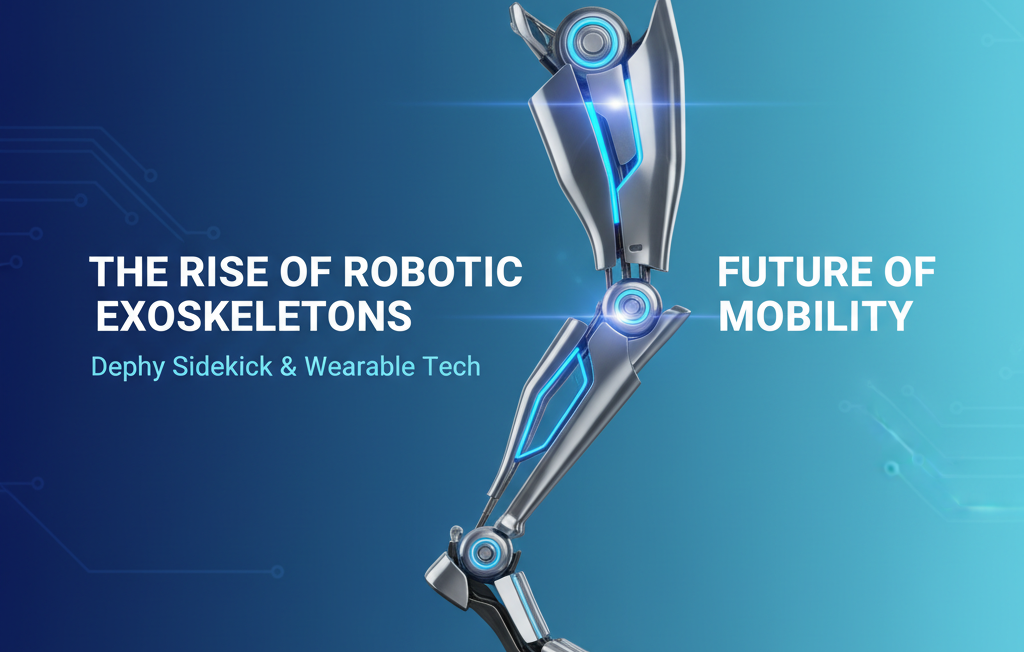
The Rise of Robotic Exoskeletons: Dephy Sidekick and Wearable Technology
Robotic exoskeletons are no longer confined to science fiction. At CES 2026, the Dephy Sidekick and various other wearable technologies showcased just how far we've come. These advancements signify a turning point in consumer and professional robotics, moving beyond niche applications to become integral components in various sectors.
Key Takeaways
- Robotic exoskeletons are being rapidly adopted in both industrial and personal applications.
- The Dephy Sidekick enhances mobility and strength, supporting users in daily activities and rehabilitation.
- Exoskeletons have shown promise in reducing workplace injuries, especially in physically demanding jobs.
- The technology is evolving, with lighter materials and improved battery life enhancing user experience.
- Companies are investing heavily in exoskeleton research and development to meet growing demand.
- Exoskeletons are gaining traction in healthcare, aiding in physical therapy and recovery.
- Consumer models are becoming available, making the technology accessible for personal use.
A New Era of Mobility
The Dephy Sidekick is at the forefront of this revolution. Designed to assist individuals with mobility challenges, it offers a seamless blend of technology and human movement. Users report feeling empowered, as the Sidekick allows them to perform tasks that were once difficult or impossible. This exoskeleton not only helps with physical rehabilitation but also offers a new level of independence.
Imagine a construction worker who can lift heavy materials without straining their back. Or a senior citizen who can walk unaided for the first time in years. These scenarios are becoming a reality thanks to innovations like the Dephy Sidekick and others showcased at CES.
Industrial Applications: Reducing Risks and Boosting Productivity
In industries where manual labor is prevalent, exoskeletons are proving to be more than just a novelty. They are a practical solution to a longstanding problem: workplace injuries. According to a study by the National Institute for Occupational Safety and Health, exoskeletons can reduce the risk of musculoskeletal injuries by up to 50%. This is a significant statistic for businesses that prioritize employee safety and productivity.
Manufacturers and logistics companies are beginning to integrate exoskeletons into their operations. Workers equipped with these devices can lift and carry heavy objects with less strain, which not only enhances productivity but also minimizes downtime due to injuries. Companies like Tesla and Amazon are already exploring partnerships with exoskeleton manufacturers to improve their workforce efficiency.
The Role of Wearable Technology
Wearable technology is evolving alongside robotic exoskeletons, with advancements in sensors and connectivity. The integration of smart technology into exoskeletons allows for real-time feedback and adjustments based on user performance. For instance, sensors can detect fatigue levels and adjust the support provided, ensuring that users remain comfortable and safe.
Moreover, the data collected from these devices can offer valuable insights into user behavior and health. This opens up new avenues for research in physical therapy and rehabilitation. Patients can receive tailored treatment plans based on their progress, leading to better outcomes.
Consumer Market: Accessibility and Personalization
The goal of making exoskeletons more accessible is gaining traction. Consumer models are beginning to emerge, allowing everyday individuals to benefit from this technology. Companies are focusing on creating lighter, more affordable options that cater to personal needs. The Dephy Sidekick, for example, is designed to be user-friendly, with intuitive controls that require minimal training.
As the market expands, customization will play a crucial role. Users will be able to select features that best meet their specific requirements, whether for rehabilitation or enhancing athletic performance. This personalization factor is key to increasing adoption rates among consumers who may have previously viewed exoskeletons as too specialized or expensive.
Conclusion: Embracing the Future
The rise of robotic exoskeletons, highlighted by innovations like the Dephy Sidekick, signals a dramatic shift in how we approach mobility, work, and rehabilitation. As these technologies become mainstream, they invite us to rethink our limitations and the possibilities of human augmentation. The future is here, and it is more empowering than ever. Embracing these advancements could redefine our relationship with physical capabilities, making the once impossible, possible. The question now is: how will you leverage this technology in your life or work?
Entertainment

Samsung Unveils World's First 130-Inch Micro RGB TV with Next-Generation Color Technology

Hyperloop Technology 2026: Testing High-Speed Transportation at 600+ MPH

Aerospace Breakthroughs: Pantuo Pantala eVTOL and the Future of Urban Flight

How Vincent Van Gogh really lost his ear
Gaming

The LHC's Two Decades of Discovery: From Higgs Boson to Exotic Hadrons

Everything you wanted to know about The OC
History

The Evolution of Particle Accelerators: From 1980s Theory to LHC Reality

TIME's Best Inventions Hall of Fame: 25 Iconic Innovations Transforming Modern Life

JSON Schemas for Solar Panels in Energy3D, EnergyPlus, and Detection Datasets

Smart Home Robotics Evolution: From Vacuums to Climbing Rovers
Read More
Everything you wanted to know about The OC
Jane Jeffries|

Atlantis: truth or myth?
Laurie Lucas|

Some of the most wildly inaccurate historical dramas on TV and the misconceptions they bring.
Laurie Lucas|

How Vincent Van Gogh really lost his ear
Jane Jeffries|

Why do coincidences always seem to happen all the time?
Jane Jeffries|